
Beyond Takedowns: Why the Listing Is Not the Problem
The takedown numbers look good. A brand protection team removes thousands of infringing listings each month. The dashboard shows progress. And then, predictably, the same sellers reappear under new account names, with new listings that look almost identical to the ones just removed.
The listings were never the problem. They were the output. The seller network generating them continues operating because takedowns, by design, address the output — not the infrastructure that produces it.
Most marketplace enforcement is organized around this mismatch. The metrics measure removals. The underlying seller networks measure something else: the cost of getting removed versus the revenue generated before removal. For organized infringers, that math still works in their favor.
How Marketplace Infringement Actually Works
Brand protection teams sometimes speak about infringing listings as though each one is a separate problem to be solved. The reality on the seller side is more organized than that. Three patterns account for most of the volume:
Counterfeit goods distributed through coordinated seller accounts
The largest counterfeit networks do not operate from single accounts. They maintain clusters of accounts across marketplaces — some active, some dormant — that rotate as enforcement removes individual listings. When Chanel pursued counterfeit goods on Amazon, the case required identifying not just the listings but the store network selling them, which led to compensation of approximately $3 million — but only after the full scope of the network was established. A listing-level approach would have left the distribution structure intact.
Unauthorized sellers exploiting authorized distribution gaps
The unauthorized seller problem is structurally different from counterfeiting, and enforcement teams sometimes conflate them. Unauthorized sellers often have legitimate access to real products — through distributors, diversion, or family relationships — and sell them through channels that violate distribution agreements. The products may be genuine. The seller relationship is not. Identifying unauthorized sellers requires mapping the authorized distribution chain well enough to spot where products are leaking into channels they should not reach.
Trademark infringement by platforms that do not adequately police uploads
The Atari v. Redbubble case established an important precedent: platforms that do not adequately police user-generated content can face liability for trademark infringement that appears on their platform. For brand protection teams, the implication is that enforcement is not solely a takedown task — it requires demonstrating to the platform that infringing content is appearing systematically, which is an evidentiary standard that requires organized, documented evidence, not individual reports.
Why Infringing Sellers Keep Reappearing After Takedowns
The persistence of infringing sellers is not a mystery. It follows from the specific operational limits of how most marketplace enforcement is structured:
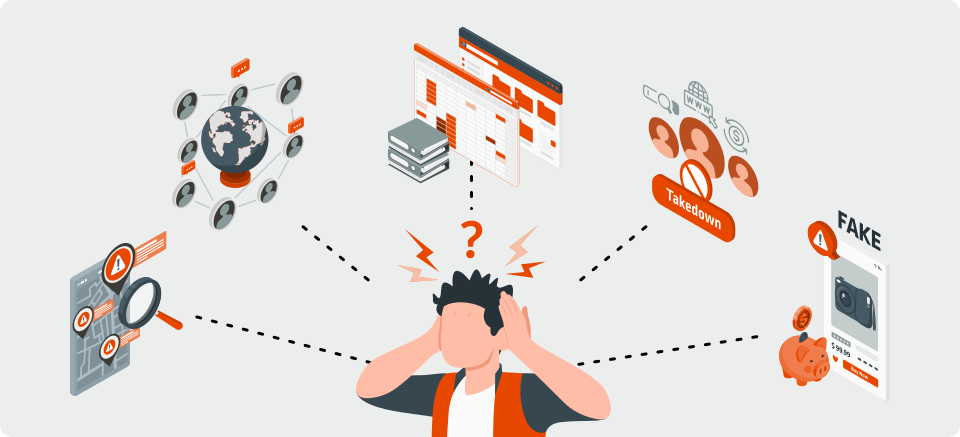
Enforcement targets listings, not seller identities
A takedown removes a listing. The seller account that posted it — and the registration, payment, and fulfillment infrastructure connected to that account — remains. Organized infringers know this and maintain multiple accounts in reserve. The cost of losing one listing is close to zero when the account persists and can relist immediately.
The infringing network spans more platforms than any single monitoring contract covers
A seller operating on Amazon is often the same seller operating on eBay, AliExpress, and a standalone Shopify storefront. Brand protection software vendors have varying relationships with different marketplaces. A team that monitors three platforms comprehensively may be missing the majority of a seller’s actual volume, which continues undetected elsewhere.
Seller identity is harder to establish than listing content
Identifying a listing as infringing is usually straightforward — brand elements, product images, and descriptions provide enough evidence. Identifying the seller behind multiple accounts is an investigative problem that requires connecting registration data, payment patterns, shipping addresses, and account behavior across platforms. Without that connection, enforcement teams repeatedly encounter the same sellers without accumulating the evidence to act against the seller entity rather than the individual listing.
Takedown processes are not designed to build structural evidence
The workflow for marketplace enforcement — detect, report, remove, document — is organized around speed. The fastest teams close the most takedowns. But the documentation generated in that workflow is rarely structured to support a broader enforcement action: an injunction, a platform suspension, a customs referral, or a criminal referral. Speed and evidence quality pull in opposite directions when enforcement is measured by volume.
The 80/20 pattern holds, but identifying the 20% requires investigation
Research consistently shows that a minority of sellers generate the majority of infringing volume. Knowing that in principle and being able to act on it in practice are different problems. Identifying the highest-impact sellers requires connecting data across cases, platforms, and time — a task that isolated listing-level workflows are not designed to support.
The pattern repeats because the enforcement model was not designed to break it. Addressing the seller network requires a different unit of analysis than the listing, and different evidence standards than a platform takedown report requires.
What Changes When Enforcement Targets the Seller Network
Map accounts to seller entities, not just listings
The first shift is analytical: tracking which accounts are connected to the same underlying seller. Registration patterns, payment relationships, shipping addresses, and behavioral similarities across accounts create the evidence base for a seller-level enforcement action. This requires persistent records, not case-by-case snapshots.
Build evidence packages, not just takedown records
A takedown report contains enough information to justify removal of a listing. An enforcement action against a seller network requires something more: a documented history of connected accounts, a timeline of infringing activity, and evidence that connects the accounts across platforms. Building that case requires structuring takedown data so it accumulates into something usable, not just archiving it.
Extend enforcement beyond marketplace platforms
Stopping a seller on one marketplace without addressing the seller’s presence on others, or the storefront they operate independently, leaves most of the network intact. Effective enforcement coordinates across platforms — including domain registrars, payment processors, and where appropriate, customs authorities — so that the network loses infrastructure, not just listings.
Prioritize by seller impact, not by listing volume
The sellers generating the most infringing volume are not necessarily the ones generating the most takedown work. A sophisticated seller maintaining many smaller accounts generates dispersed enforcement activity without triggering the volume threshold that would flag them as high-priority. Identifying them requires connecting the accounts, not just counting the listings.
Use detected listings as network entry points
Every infringing listing carries information about the seller beyond the listing itself: account history, connected identifiers, platform behavior patterns. Treating a detected listing as an entry point — what else is connected to this account, what other accounts share this registration pattern — converts routine monitoring into structured network intelligence.
How Hubstream Supports Seller-Network Investigation
Hubstream is built for the investigative motion that marketplace enforcement requires when the goal is the seller, not the listing.
Persistent seller profiles that connect accounts across platforms and over time, so enforcement history accumulates against the seller entity rather than individual listings.
Link analysis that surfaces connections between accounts, registration data, payment relationships, and shipping patterns — the evidence base for seller-level enforcement actions.
Structured case records that convert takedown documentation into evidence packages usable for platform suspensions, legal proceedings, and customs referrals.
Cross-platform investigation that connects infringing activity across marketplaces, social channels, and independent storefronts into a single view of the seller network.
The metric that matters in seller-network enforcement is not how many listings were removed this month. It is how many sellers lost enough infrastructure that relisting became operationally difficult. That shift in measurement reflects a shift in the unit of work — and requires an investigative environment built to support it.