When Every Fake Is Unique: What Generative AI Actually Broke in Brand Protection
Security researchers tracking AI-generated impersonation sites have identified roughly 100,000 websites cloning close to 200 brands, built with tools that can stand up a convincing storefront in minutes from a short prompt, no coding required. That volume is the headline. The detail that matters more for enforcement teams is buried underneath it: a well-resourced fraud operation can now take a working template and generate thousands of unique, customized variations of it in minutes, specifically to avoid the clustering analysis that used to catch a batch of near-identical fakes in one pass.
That’s a different problem than “there are more fakes now.” It’s that the fakes no longer look like each other, which is exactly the property most detection systems have relied on.
Three Places the Same Shift Shows Up
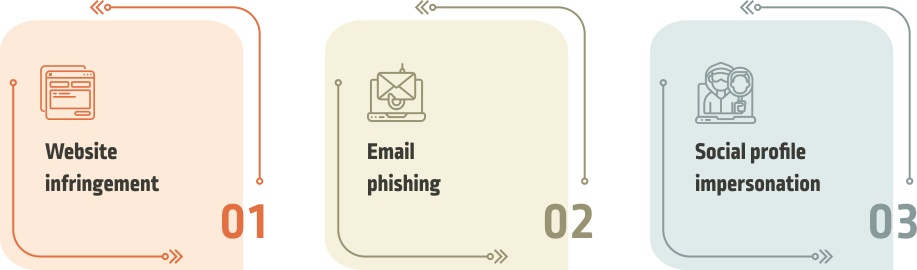
Website cloning
A convincing counterfeit storefront used to take real effort to build, which meant a brand’s takedown team could reasonably expect to see the same template reused across multiple domains. Generative site builders remove that constraint. Ahead of the 2025 holiday season, researchers tracked more than 18,000 newly registered domains using seasonal lures like “Black Friday” and “Flash Sale,” with roughly 3,000 already hosting phishing pages or fraudulent storefronts, each one easy to make just different enough from the last to dodge a simple similarity match.
Email and messaging phishing
The underlying tactic isn’t new. Yahoo was already the most impersonated brand in Q4 2022 phishing activity, well before generative tools were widely used to write the messages. What’s changed is that AI-written phishing content now varies its tone, phrasing, and structure message to message, making the kind of pattern-matching that used to flag a mass campaign from repeated language far less reliable.
Social profile impersonation
On platforms like TikTok and Instagram, AI-generated product photography now produces convincing counterfeit listings, sometimes styled closely enough to a real luxury product that a buyer has no visual way to tell the difference before a purchase. Each listing can be rendered fresh, meaning the exact image that got one account suspended doesn’t need to reappear anywhere else.
Why Detection Built on Repetition Is Losing Ground
Most brand protection detection, image matching, text similarity, template fingerprinting, works on an assumption that held for years: a fraud operation reuses its assets because building them is expensive. Generative tools made that assumption false for a large share of current activity. Deloitte has projected AI-assisted scams could push global losses toward $40 billion by 2027, and the mechanism behind that growth isn’t more attackers. It’s the same attackers producing more variation per attacker.
The honest question this raises isn’t whether image-recognition and text-matching tools need to get better at spotting AI-generated content, though that work continues and matters. It’s whether content-level detection alone was ever going to be a durable strategy once the cost of generating unique content collapsed. An arms race against generation speed is one a defender starts already behind.
What Doesn’t Get Regenerated as Easily
The more durable signals sit one layer below the content: the hosting infrastructure, domain registration patterns, payment processors, and account behavior that a fraud operation still has to touch even when every image and every sentence is unique. PayPal’s fraud models are a useful reference point here, not because the analogy is exact, but because of what they choose to analyze. Rather than trying to pattern-match the content of a transaction, PayPal’s systems evaluate hundreds of behavioral signals per transaction in real time, velocity, network relationships, account history, across billions of transactions a year. The content varies. The behavioral graph underneath it is much harder to regenerate on demand.
The RealReal applies a version of the same logic to physical goods: AI flags items as higher or lower risk, but trained human authenticators still make the final call on anything flagged high-risk, because a generated product photo can be perfect while the physical item behind it still isn’t. Content-level signal narrows the pool. It doesn’t replace the judgment needed once a specific case is in front of a person.
Questions Worth Asking About Your Own Detection Stack
Does your current detection depend on a new fake resembling a previously seen one, in image, template, or wording? If a fraud operation varies all three tomorrow, does your system still recognize it as the same actor, or does the case reset to zero? Are you tracking anything below the content layer, domain registration timing, hosting provider, payment processor, redirect infrastructure, that would still connect two attacks even if nothing on the surface matches? And when a listing is confirmed as generated fraud, does that finding get checked against infrastructure from prior cases, or only against other content?
This is the layer an AI-native investigative environment like Hubstream is built to hold onto: not just whether a given image or listing looks fraudulent, but whether the infrastructure behind it connects to a case your team has already worked, even when the content generated for this attempt has never been seen before.
The next 100,000 AI-generated impersonation sites won’t look like the last 100,000. That’s the point of generating them. The infrastructure paying for the domains, hosting the pages, and processing the transactions behind them is a much harder thing to make disappear, which is where enforcement attention is worth moving next.