When the Case Closes, the Counterfeit Network Doesn’t
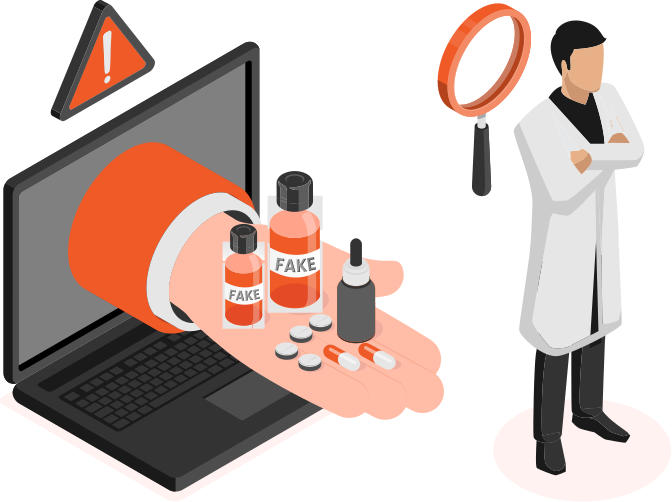
When the DEA published its 2024 National Drug Threat Assessment, the counterfeit pill operation it described read as a clean result: millions of fake pills pulled from circulation, a distribution network mapped and dismantled in a coordinated, multi-state action. What the assessment does not settle is what happened to the parts of that network one step removed from the raid — the press that cast the counterfeit tablets, the entity behind the shipping labels, the courier layer that never appears on an indictment.
Those pieces rarely surface in the same case file as the seizure that made the news. That gap is not a gap in effort. It is a gap in what a case is built to hold.
The scale involved makes the gap worth taking seriously. The World Health Organization estimates the counterfeit pharmaceutical trade generates $431 billion a year. No single raid, however well executed, is sized to that number. The more useful question is not whether counterfeit medicine is a growing threat — every practitioner in this field already knows that — but whether the unit enforcement uses to measure success, the individual case, is the right unit for a supply chain that is not organized as individual cases at all.
A Pattern Only Visible Across Cases, Not Within Them
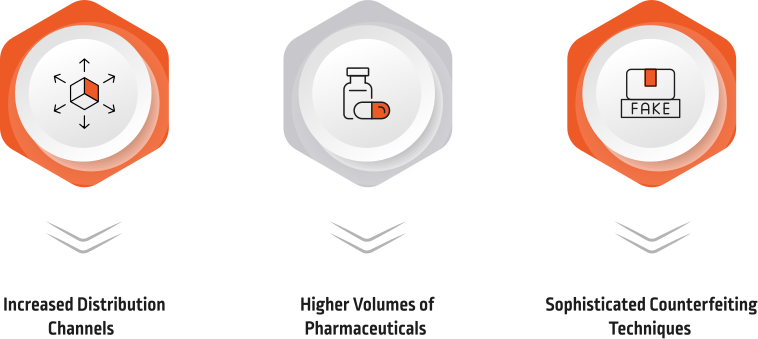
Each of these is treated, procedurally, as a discrete event with its own file, its own jurisdiction, its own close date. What is harder to see from inside any one of them is whether the sourcing, the packaging supplier, or the payment routing on this year’s cluster matches something logged in a case that closed two years and one continent ago. That comparison is rarely made, not because investigators lack the instinct for it, but because nothing in the case structure carries it forward automatically.
Two Prosecutions, One Reappearing Infrastructure
The clearest evidence of the structural problem sits in the prosecutions that already succeeded. Over roughly two years, counterfeiters distributed 85,247 counterfeit bottles of Gilead’s HIV medications, valued above $250 million, into legitimate U.S. pharmacy supply chains. Separately, Lazaro Hernandez, a South Florida poker player, ran a $230 million scheme built on the same underlying tactic — relabeling and swapping the contents of genuine pill bottles, then reselling them to pharmacies at a discount. He pleaded guilty and received a 15-year sentence.
Both cases involved the same drug class, the same relabeling mechanic, and the same point of entry: distributors willing to move product without asking where it originated. Both were prosecuted as self-contained matters. Neither case file, as built, was designed to ask whether the wholesalers, the bottle sources, or the shell companies behind one scheme had also touched the other. That is not a criticism of either prosecution, which achieved what it set out to achieve. It is an observation about what a case is scoped to answer, and what it is not.
This is the deeper issue underneath the more visible one. The counterfeit pharmaceutical supply chain, from manufacturing through relabeling through cross-border distribution through the shell companies that launder the proceeds, operates as a persistent network with recurring entities and relationships. Enforcement, by design, operates as a sequence of bounded cases, each scoped to a jurisdiction, a set of defendants, and a closing date. A network built to reconstitute itself after a takedown is, structurally, well matched against an enforcement model built to close the file once the takedown is complete.
Regulation Solved for Traceability, Not for Case Memory
The strongest existing countermeasures were built with exactly this mismatch in mind, at least for the supply chain’s legitimate side. The U.S. Drug Supply Chain Security Act and the EU’s Falsified Medicines Directive both require serialization and unique identifiers so a legitimate product’s path from manufacturer to pharmacy can be verified at each handoff. That is real progress against counterfeit product entering a clean chain.
It does not, by itself, solve the investigative version of the same problem. Serialization tells you whether a specific bottle is authentic. It does not tell an investigator opening a new case in Ohio that the shell company registering the return address matches one flagged in a Florida prosecution three years earlier, or that a courier route resembles one Interpol logged during Pangea XIV. That correlation depends on someone remembering, searching, or being told — and today, that memory lives in individual investigators and individual case files, not in any system built to carry it across cases and jurisdictions.
The harder question, then, is not whether detection techniques are improving. AI-driven pattern detection, mobile verification tools, and blockchain-based tracking are all real, incremental gains on the product-authentication side. The harder question is whether a seizure-and-prosecute model, however well resourced, can ever outpace a supply chain engineered to reconstitute under new names once each case closes — if nothing preserves what was learned about the entities behind it.
What Carrying a Network Across Cases Would Require
Closing that gap does not require more raids or a bigger version of Pangea. It requires treating the entities inside a case — the shell company, the packaging supplier, the domain registrant, the courier — as things worth resolving and re-identifying the next time they appear, rather than re-discovering from scratch in a new jurisdiction under a new name. That is a data and workflow problem as much as an investigative one: most of what would make the comparison possible already exists somewhere in prior case records, corporate filings, and seizure reports. It is rarely connected.
This is where the work has been easiest to lose. An investigator picking up a new counterfeit pharmaceutical case rarely has the earlier file where a piece of the same network surfaced under a different name. Hubstream’s approach to this problem is built around that specific loss: not as case management or a reporting dashboard, but as an investigative environment designed to hold onto the entities and relationships an investigator has already established, so that the next case touching the same infrastructure does not start at zero. Whether that closes the reconstitution gap depends on whether it becomes the connective layer between cases that, today, live and die separately — not on the tool alone.