
Thinking Like the Criminal: How LP Teams Outsmart Organized Retail Crime
It doesn’t start inside the store.
A SUV idles in the far corner of a mall parking lot. Two people inside track staff movements, camera blind spots, and security sweeps. Across the lot, two “shoppers” wander electronics, counting smartphones and quietly tugging on the display cables that hold them in place. They’re not buying. They’re building a playbook, and by the time anyone inside the store notices a problem, the reconnaissance is already finished.
Three stores and two counties later, the same vehicle, the same tools, and the same resale cadence show up again. On paper, none of it looks connected.
ORC Runs on Structure, Not Impulse
Step inside one of these crews and the roles look less like street crime and more like a supply chain: schedulers, boosters, cleaners, and fences, each with a defined function.
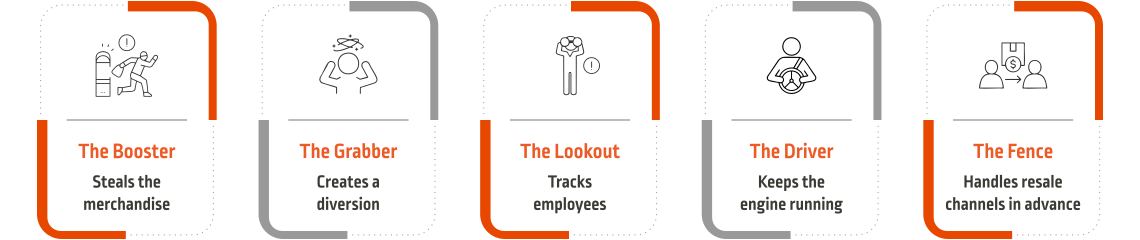
Jackets change. Aliases change. Vehicles get swapped. The routes, the timing, and the resale model don’t change, because they don’t need to. The National Retail Federation’s 2024 research found the average number of shoplifting incidents rose 93% between 2019 and 2023, with average dollar losses up 90% over the same period, and 73% of retailers reported offenders becoming more violent or aggressive. None of that is news to an LP director. What’s less discussed is why the structure keeps working even after it’s been spotted repeatedly.
Where the Case Boundary Hides the Network
An LP manager at one store recognizes the same suspect five times in two weeks. On paper, that’s five separate incidents, logged in five separate tickets, sitting in five separate spreadsheets. A retailer across town catches the same crew a week later. With no shared system and no reason to compare notes, nobody connects the two. By the time anyone assembles the full picture, the crew has already hit three more locations, and a prosecutor reviewing a single file sees a misdemeanor, not the felony-level pattern sitting one system away.
The Seattle Office of City Auditor’s 2023 review of the city’s organized retail crime response identified exactly this pattern: fragmented data, weak inter-agency coordination, and siloed reporting systems leaving investigators structurally behind crews that plan days or weeks ahead. This isn’t a detection failure. Cameras, POS systems, and LP staff often clock the same individuals repeatedly. It’s a boundary failure: the case file stops at the store, the incident stops at the day, and the network the crew actually operates as never gets assembled anywhere.
A simplified version of how that plays out: Day one, an SUV idles outside a store in City A, caught on camera, filed and forgotten. Day three, the same SUV appears in City B; a crew disables display cables and clears out in under two minutes, logged as another isolated incident. Day five, a marketplace listing surfaces in City C with identical SKUs and intact shrink-wrap. Three case files, three cities, zero connection, unless someone is specifically looking for the vehicle plate across jurisdictions, the disabling method across stores, and the listing against known fencing patterns. Do that, and the same three data points become one felony-level case with enough lead time to stage a response before the next hit.
What the Public Record Shows
In August 2025, California prosecutors announced the dismantling of a retail theft ring accused of stealing roughly $10 million in merchandise from Home Depot stores across 71 locations in five counties, using hired boosters and a resale network to move stolen goods; authorities arrested 14 people and recovered more than $3.7 million in property. That scale doesn’t build overnight. It builds across exactly the kind of isolated, unconnected incident reports that took months to assemble into one case.
The New Yorker’s reporting on organized theft rings in Los Angeles documented a similar structure from the other end: a cosmetics distributor operating as a fence for millions of dollars in stolen goods, and a case involving a suspect who used disguises and a getaway driver across multiple jewelry counter thefts, complicated further when investigators discovered a twin sibling had participated in some of the incidents. Each of these cases was solvable in hindsight. The harder question is how much earlier they could have been assembled if the connecting data points, vehicle, method, resale channel, hadn’t been sitting in different systems the whole time.
Is the Gap Legal, or Structural?
Some of the resistance to treating ORC as an organized, prosecutable network is fair skepticism. Retailers do have a financial incentive to characterize theft as organized crime rather than routine shrink, since it supports harsher penalties and legislative attention. State theft thresholds vary widely, so identical conduct can be a felony in one jurisdiction and a misdemeanor in another, and that patchwork is a legal problem no amount of data linking fixes on its own.
But the legal patchwork and the data fragmentation are separate problems, and conflating them lets the second one hide behind the first. Even within a single state, where the felony threshold is consistent, incidents recorded in isolated store-level systems rarely get compared against each other unless someone manually decides to look. That’s a workflow choice, not a legal constraint, and it’s the one LP teams have the most direct ability to fix.
Building the Case the Way the Crew Builds the Crime
Crews plan around timing, routes, and resale cadence because that consistency is what makes the operation repeatable and profitable. LP programs that track the same variables, not just faces, but vehicles, disabling methods, timing patterns, and resale listings, are working from the same structural logic the crew depends on.
That means logging security sweeps and inspection activity consistently enough to spot repeated tampering across stores rather than treating each attempt as a one-off. It means flagging a vehicle plate or a disabling method the same way regardless of which store first encountered it. And it means treating a marketplace listing with matching SKUs as investigative evidence, not just a customer service curiosity. None of this requires predicting where a crew will strike next with certainty. It requires making sure that when the same signal appears twice, someone is in a position to notice.
This is the kind of cross-incident correlation that case environments built for the work can support directly, linking vehicles, methods, and resale signals across stores and jurisdictions so that the fifth incident doesn’t have to wait for a person to manually remember the first four. Hubstream’s loss prevention environment is built around that kind of correlation rather than incident logging alone, though the underlying requirement, connecting signals across store and system boundaries, holds regardless of which tools a program uses to do it.
Questions Worth Running Against Your Own Program
Before the next parking lot reconnaissance turns into a five-store hit: how many incidents in your system share a vehicle, a method, or a resale channel with another incident that nobody has actually compared them against? If a crew hit three of your stores in different counties this month, would that show up as one case or three? And when a prosecutor asks for a pattern, are you producing one, or building it from scratch under deadline?
Flipping the Script
The SUV still idles in the parking lot. The crew still believes the outfits, the swapped plates, and the store-by-store approach keep them invisible. What’s changed isn’t the crew’s behavior, it’s whether the retailer’s own case file was built to notice that the third incident this month is the same story as the first two, just wearing a different jacket.
Outsmarting a business means dismantling its supply chain, not just interrupting its transactions. The stores that get there first aren’t the ones with more cameras. They’re the ones whose case files don’t stop at the door.