
Human + AI Investigations: The Work Didn’t Disappear, It Moved to Verification
In 2021, the National Center for Missing and Exploited Children’s CyberTipline received 29.3 million reports. No triage team, however staffed, reviews that volume manually with any consistency. Prioritization systems built to rank those tips from most to least urgent are usually described as a labor-saving win: the backlog shrinks, the most severe cases surface faster, investigators lose less time to manual sorting.
That description is accurate as far as it goes, and it also skips the more useful question. The work of reviewing 29.3 million tips didn’t vanish when a model started ranking them. It moved. Someone still has to look at the top of that ranked list, evaluate whether the model’s read of urgency holds up, and decide what happens next. The question worth asking isn’t whether AI helps here, since it clearly does. It’s what kind of work investigators are now doing instead, and whether anyone designed for that shift on purpose.
What the Backlog Actually Looked Like Before Prioritization
The manual version of this problem wasn’t abstract. Analysts worked cyber tips roughly in the order they arrived, or by whatever informal urgency cues a case worker could infer from a subject line or a partial report. High-priority leads (active exploitation, an identifiable child, an ongoing threat) sat in the same queue as tips that turned out to be duplicates, spam, or misdirected reports. Time spent sorting was time not spent on the cases where it mattered.
Systems that rank tips by risk signal, image content, and cross-case linkage change that queue order. That much is a genuine improvement, not a marketing claim. The open question is what happens on the other side of the ranking.
The Verification Layer Nobody Budgets For
A ranked list is not a resolved case. Every flagged tip still requires a human to confirm the model read it correctly: that the image match is a real match, that the account linkage isn’t coincidental, that the “urgent” label reflects the actual content rather than a surface-level keyword pattern. That confirmation step is real investigative labor, and it scales with the number of things the model flags, not with how accurate the model is.
This is where the efficiency story gets complicated. If a system flags cases at a rate that outpaces the team’s capacity to verify them, the backlog doesn’t disappear. It relocates from the intake queue to the review queue, and the review queue carries higher stakes per item because everything in it is already labeled “high priority.” An analyst working through a review queue built this way is not doing less work. They are doing different, more consequential work, often without additional staffing attached to the shift.
Where the Same Pattern Shows Up Beyond CyberTips
The verification burden isn’t unique to tip prioritization. A collaborative project between Syracuse University, the Onondaga County Center for Forensic Sciences, and the New York City Office of Chief Medical Examiner paired data-mining algorithms with human analysts to untangle complex DNA mixtures. The algorithm narrows the field of plausible profile combinations. A forensic analyst still has to determine which of those combinations holds up to scrutiny, because a DNA match that can’t survive cross-examination isn’t useful evidence, regardless of how it was generated.
The Austin Police Department’s AI-driven online reporting system for non-emergency complaints follows a similar shape. The chatbot handles intake across voice, text, and web. Someone still has to review what it captured before it becomes an actionable report, particularly when the incident described doesn’t fit the categories the system was built to recognize cleanly.
Stanford psychologist Jennifer Eberhardt’s analysis of nearly 600 Oakland police traffic stops points at the same gap from the opposite direction: body cameras generate more footage than any department could review by hand, and AI analysis of that footage is valuable precisely because manual review was never going to happen at scale. The tool doesn’t remove the need for judgment about what the footage shows. It’s the only way judgment gets applied to footage that would otherwise go unwatched entirely.
The Harder Question: What Happens When the Flag Is Wrong
None of this is an argument against these tools. It’s an argument for being specific about what they change. A prioritization or detection system introduces a new failure mode alongside the one it fixes: false confidence in a flag that turns out to be wrong, and false urgency around a case that isn’t actually the priority the model says it is.
Predictive policing tools built on historical crime data illustrate the risk in its sharpest form, reinforcing patterns of over-policing in neighborhoods that were already over-surveilled, because the training data reflects where officers were sent before, not where crime actually occurred. Risk-assessment tools used in sentencing and parole decisions carry a comparable risk for the same underlying reason. The technology doesn’t introduce bias out of nowhere. It automates and scales whatever bias already existed in the historical record it learned from.
That’s a different problem than “AI makes mistakes.” It’s a problem of what happens procedurally when it does. Who reviews a flagged case that turns out to be a false positive, and does that review happen before or after the investigative resources were already committed? Is the model’s reasoning visible enough that an investigator can explain, in a report or in court, why a given case was treated as urgent?
What a Deliberately Designed Verification Workflow Looks Like
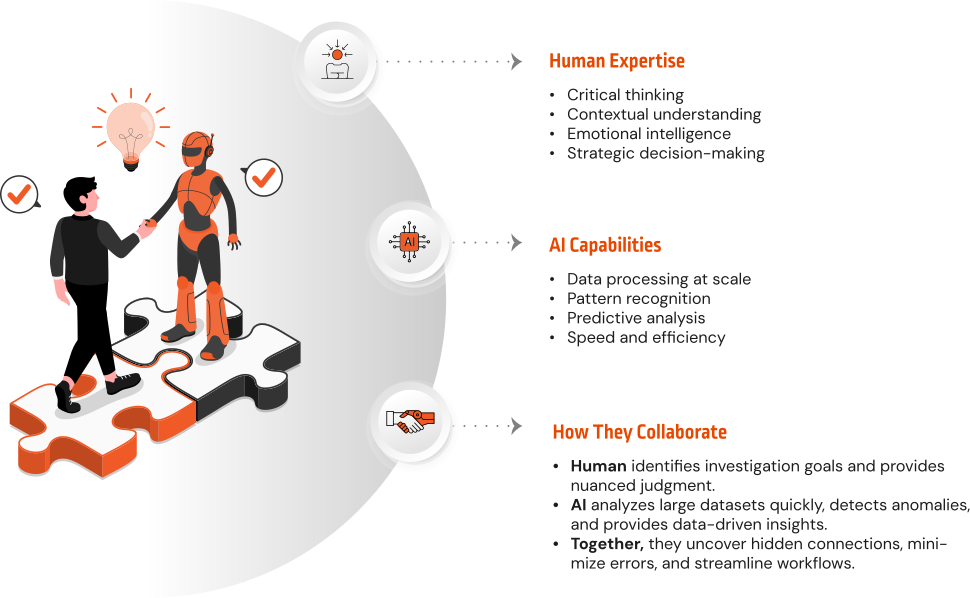
The agencies getting real value from these systems tend to share a specific discipline: they treat the review step as a designed part of the workflow, not an afterthought absorbed by whoever is on shift. That means the ranked list a model produces is only as useful as the interface an investigator uses to challenge it. A flag with no visible reasoning behind it forces an investigator to either trust it blindly or redo the analysis manually, which defeats the purpose either way.
Hubstream’s approach to cyber tip prioritization reflects that distinction: the goal isn’t to hand an investigator a ranked list and walk away, but to surface why a tip ranked where it did, so the verification step is a review of reasoning rather than a re-investigation from scratch. That difference determines whether the review queue is genuinely faster than the old intake queue, or just a relabeled version of the same bottleneck.
Regulatory frameworks are starting to formalize this expectation rather than leave it to individual agencies. The EU AI Act classifies law enforcement AI as high-risk and requires documented risk management and transparency around how these systems reach conclusions. California’s AI Safety Law sets comparable expectations for large-scale systems. Neither framework treats explainability as optional, which suggests regulators have reached the same conclusion investigators already know from experience: a flag you can’t interrogate is a flag you can’t fully trust.
Questions Worth Asking Before Adopting the Next Tool
Before treating a new AI capability as a net time saver, it’s worth examining where the hours actually go. Does the system explain its reasoning well enough that verification takes minutes rather than a full re-investigation? Is there a documented process for what happens when a high-confidence flag turns out to be wrong, and who owns that review? Has anyone measured whether investigator time shifted from search to verification, or whether it was genuinely reduced?
The Redistribution, Not the Replacement, Is the Real Story
The backlog of 29.3 million cyber tips didn’t get smaller because a machine started doing the work humans used to do. It got more tractable because the work was reorganized, and an investigator’s expertise moved from finding the needle to confirming it’s actually a needle. That’s a meaningful shift. It’s also a different job than the one most agencies are staffing for, which raises the next question worth asking: not whether AI belongs in the investigative workflow, but whether the workflow around it was ever redesigned to match.