The Price Gap Was the Signal. Inflation Just Erased It.
A brand protection analyst running a routine triage pass in early June would have found nothing to escalate. Counterfeit listing volume for a mid-market consumer brand was flat against the prior quarter. The automated price-anomaly flags, the alerts built to fire when a listing sits far enough below MSRP to suggest a fake, stayed quiet. By every measure the model was tuned to watch, the queue said the same thing it had said for months: no new risk here.
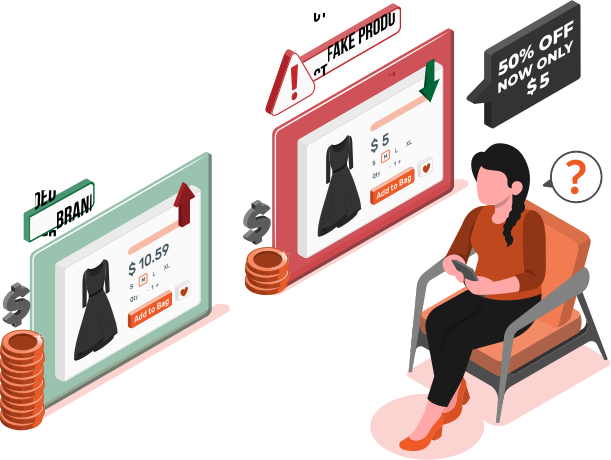
What the queue could not see was that the brand’s own retail price had moved twice in ten weeks, pushed up by tariff surcharges the finance and category teams had approved without looping in brand protection. The gap between the genuine product and the counterfeit listings sitting one search result below it had gone from a 40 percent discount to 12 percent. Nothing in the enforcement workflow was built to register that. Listing volume hadn’t changed. Seller sophistication hadn’t changed. The floor had moved, and the model kept measuring distance from a floor that no longer existed.
Retailers Are Absorbing Cost Differently, and That Divergence Is the Real Signal
The price movements behind that scenario are not hypothetical. Retailers long associated with low prices, including Walmart, are passing tariff and supply chain costs on to consumers, while others are choosing a different path. Business Insider’s reporting on the divergence between Walmart and Home Depot is instructive here: Walmart has opted to raise prices to offset tariff exposure, while Home Depot has pursued supplier diversification specifically to hold prices steady. Two comparable retailers, facing the same trade policy environment, arrived at opposite pricing strategies. That divergence means the price of a genuine product is no longer a stable reference point even within a single retail category, let alone across the marketplaces brand protection teams monitor.
For a triage model built on historical price baselines, this is a problem before it is an opportunity for counterfeiters. A threshold calibrated against last year’s MSRP does not know that this year’s MSRP moved, or that it moved differently depending on which retailer’s supply chain decisions it reflects. It only knows that a listing priced at what used to look suspiciously cheap now looks like a legitimate retail price, and a listing that used to look normal may now sit inside what the model still treats as safe range.
Why Volume-Based Triage Misreads a Demand-Side Shift
Most brand protection programs prioritize enforcement using a fairly consistent set of signals: listing volume, channel (marketplace reputation, social commerce, standalone sites), image and text match confidence, and price deviation from a known-good baseline. That framework was built to catch counterfeiters getting better, more listings, better images, more convincing storefronts. It was not built to catch consumers getting squeezed.
When the driver of counterfeit demand is macroeconomic rather than a change in counterfeiter capability, the signals a triage model watches can stay flat while the underlying risk moves. Price-anomaly thresholds tuned to historic norms interpret a narrowing genuine-to-fake price gap as the market normalizing, not as a warning. Volume-based prioritization waits for a spike in fake listings to confirm that something changed, but the actual shift, the moment consumers start treating a “dupe” as a rational substitute rather than a compromise, happens during the price adjustment window itself, before volume ever moves. By the time listing volume is high enough to trip an alert, the behavioral shift that made the counterfeit attractive has already occurred and, in many cases, already normalized among the exact buyers a brand can least afford to lose.
This is the deeper issue: a prioritization model built around counterfeiter sophistication is structurally different from one built to detect demand-side realignment. The first asks, “did the threat get better at faking us?” The second has to ask, “did we get more expensive relative to the alternative, and did anyone notice before we did?” Most programs are still only equipped to answer the first question.
The Evidence Is Not Ambiguous, Even If the Response Has Been
The scale of the underlying market removes any doubt about stakes. The OECD and EUIPO estimate that global trade in counterfeit goods reached $467 billion, a figure large enough that it is no longer meaningfully described as a secondary or opportunistic market. It is a parallel supply chain responding to the same price signals legitimate retail responds to. The consumer safety dimension is not abstract either. ICE’s consumer-facing guidance on counterfeit risk documents the tangible harm, from unregulated materials to products that fail under normal use, that accompanies the “it looked close enough” purchasing decision inflation is quietly encouraging.
None of this is new information about counterfeiting as a category. What is underexamined is the mechanism connecting a retailer’s tariff-pricing decision to a shift in which triage flags fire six weeks later, and whether the enforcement cadence built around “detect, report, remove” can move at the speed of a pricing decision made in a finance meeting a brand protection team never attends.
The Harder Question: Are You Measuring the Counterfeiter or Measuring the Price?
It is worth asking directly whether a program’s prioritization logic is actually tracking counterfeit risk, or whether it is tracking a proxy, price deviation from a fixed baseline, that only works when the baseline itself is stable. Inflation and tariff volatility have made that baseline unstable in a way that is structural, not seasonal. A model that cannot ingest a retailer’s pricing change as an input, and recalibrate its anomaly threshold accordingly, will keep producing a queue that looks calm right up until it doesn’t.
This is where OSINT and monitoring tools earn their keep or fail to. The task that matters is not “give the analyst real-time visibility,” which says nothing about what changes in practice. The task is narrower and more specific: an analyst reviewing a category needs to know, at the moment a retail price shifts, whether the price gap to known counterfeit listings has moved enough to change enforcement priority, without waiting for a separate volume-based alert to catch up days or weeks later. The friction today is organizational as much as technical. Pricing data lives with finance and category teams; counterfeit monitoring lives with brand protection or legal; the two data sets rarely meet inside the same workflow, so the context that would explain why a threshold should move, a tariff surcharge, a supplier switch, a promotional price cut, gets lost between systems even when both data sets technically exist.
Closing that gap is less about faster detection and more about which inputs a monitoring workflow is allowed to treat as first-class signals. A program that can connect genuine-price movement to counterfeit-price monitoring in the same view is asking a fundamentally different question than one that waits for listing volume to cross a static line. This is the kind of connective, cross-source investigative work that an AI-native environment built for deep discovery, rather than single-purpose alerting, is suited to. Hubstream’s approach, linking evidence, pricing signals, and seller relationships inside one investigative workspace rather than across disconnected tools, is built on the premise that the connection between data sets matters more than the speed of any single alert.
Questions Worth Raising Before the Next Pricing Cycle
A few questions are worth putting to a triage model directly, ideally before the next tariff adjustment or promotional cycle rather than after. Does the price-anomaly threshold update when a monitored brand’s own retail price changes, or does it stay anchored to a baseline set months ago? Does anyone on the brand protection team see pricing decisions before they are public, or only after competitors and counterfeiters have already reacted to them? When volume-based alerts do fire, is there a way to determine whether the underlying shift happened weeks earlier during a price adjustment window that produced no alert at all? And if the answer to any of these is no, is that a gap in tooling, or a gap in which teams are talking to each other.
The Queue Will Look Calm Again Next Quarter
The analyst reviewing next quarter’s triage queue will likely see the same thing: flat volume, quiet anomaly flags, a market that appears stable because the model reports it as stable. Whether that calm reflects reality or reflects a threshold that hasn’t caught up to the last price adjustment is not a question the queue can answer on its own. It is a question about what the model was built to notice, and whether pricing decisions made elsewhere in the business are treated as relevant to brand protection before or after the damage is visible in listing volume.