Why the U.S. Notorious Markets List Tells Only Half the Story
A market can be named, shamed, and dropped from the U.S. Trade Representative’s Notorious Markets List — and still return years later, moving the same counterfeit goods through the same channels. Taobao’s record with the list is the clearest case: it came off after Alibaba invested heavily in enforcement technology, then reappeared. That kind of persistence raises a harder question than the list itself is built to answer. What does naming a market actually change, and what does it leave untouched?
Each year, the Office of the United States Trade Representative publishes exactly that kind of accounting: a global inventory of online and physical marketplaces reported to facilitate large-scale counterfeiting or piracy. The 2024 edition named 38 online and 19 physical markets that, in the report’s language, “reportedly engage in or facilitate substantial trademark counterfeiting or copyright piracy.” It is not a legal indictment. It is a diplomatic instrument, Washington’s way of pricing the economic cost of counterfeits and pressuring countries and platforms toward better enforcement.
For brands on the front lines, the list only tells part of the story. Most have built private watchlists of their own: internal dashboards tracking risky platforms, seller networks, and repeat offenders in something closer to real time. Together, the public list and the private ones mark how the fight against counterfeit trade has evolved, from public diplomacy to continuous, data-driven investigation.
A Public List with Global Weight
The Notorious Markets List has become a reference point for policymakers and journalists. It is also a source of reputational risk for the companies named in it.
China’s Taobao, part of the Alibaba Group, shows both the list’s power and its limits. Once a major hub for counterfeit luxury goods, Taobao made real progress after Alibaba invested heavily in brand-protection technology and faster takedown systems, prompted by pressure from brands and regulators. Those reforms earned it removal from the list for a time. It has since reappeared, a reminder that enforcement gains are rarely permanent.
A 2025 article in the South China Morning Post reported that Taobao is now fighting a new wave of AI-generated fake product photos designed to evade detection systems. A Jing Daily report chronicled how luxury labels have struggled for years to keep pace with counterfeiters’ speed and creativity, even on platforms making good-faith efforts.
The lesson isn’t that the list failed. It’s that naming creates pressure, while lasting progress depends on continuous, coordinated action between brands, governments, and platforms, not a single annual accounting.
The Global Counterfeit Economy
A joint study by the OECD and the European Union Intellectual Property Office found that counterfeit and pirated goods accounted for about 2.3 percent of global trade in 2021, roughly $467 billion in fake products crossing borders.
That figure isn’t limited to handbags or watches. It includes counterfeit pharmaceuticals, automotive parts, and electronics, products whose failure can cause real harm. What began as an intellectual-property issue has become a public-safety one.
The same OECD study found that small-parcel shipping and postal networks have become key distribution channels for counterfeits. By splitting shipments into thousands of low-value packages, counterfeiters bypass the customs checks that would flag a large container. The counterfeit economy has adapted to exploit both global logistics and the limits of local enforcement.
From Switzerland to Shenzhen: Lessons from the Watch Industry
Few industries illustrate the deeper problem better than Swiss watchmaking.
An OECD analysis of the Swiss watch sector found that China accounted for nearly 54 percent of counterfeit watches seized worldwide in 2020 and 2021, with Hong Kong and the Netherlands serving as key transit hubs.
The report traces how counterfeit goods move through multiple jurisdictions, often changing packaging, labeling, and online identities before reaching a buyer. By the time an infringing product surfaces online, its supply chain may already span three continents.
That is the structural limit no naming exercise can fix: the list can identify a market, but it cannot untangle the supply chain feeding it. Removing a marketplace from the list does nothing to the factory, the freight forwarder, or the reseller network behind it. They resurface under a different name, on a different platform, in a different jurisdiction.
Private Lists: The Hidden Engine for Enforcement
For global brands, the real work happens far from the headlines.
Most maintain private “notorious markets” of their own: internal databases of platforms, seller aliases, and regions prioritized by risk, covering marketplaces, social media channels, and livestreaming apps where counterfeit trade increasingly thrives. The goal isn’t to shame publicly; it’s to operate efficiently. Data from brand-monitoring tools, customs records, and takedown history feeds these lists to guide investigators and legal teams.
A fashion house might track resale platforms for repeat infringers. A consumer-electronics company might monitor unauthorized “refurbished” sellers. Unlike the government’s annual report, these internal lists update daily, often faster than counterfeiters can pivot.
Transparency Laws Begin to Bridge the Gap
Governments are beginning to recognize that anonymity fuels the counterfeit economy.
In the European Union, the Digital Services Act (DSA) now requires large online marketplaces to verify and, in many cases, disclose basic seller identification data. Platforms must ensure that professional sellers provide verifiable business credentials, making it harder for repeat infringers to hide behind new accounts.
In the United States, a similar idea underpins the INFORM Consumers Act. The law requires marketplaces like Amazon, eBay, and Facebook Marketplace to verify and display key seller details, including names, business addresses, and tax IDs, for high-volume third-party sellers. The Federal Trade Commission can now fine platforms that fail to comply.
Together, these laws narrow the transparency gap. They don’t eliminate counterfeits, but they shift responsibility: marketplaces can no longer claim they don’t know who their sellers are.
Legislation Still Moves Slowly
Other legislative efforts have struggled to keep pace.
The SHOP SAFE Act of 2024, which would strengthen liability for platforms that fail to screen counterfeit goods, was introduced in Congress last year and remains at the committee stage. Supporters say it would create stronger incentives for proactive screening and collaboration between marketplaces and rights-holders. Critics worry it could impose heavy compliance costs or discourage small online sellers. For now, it remains a proposal, another sign of how slowly legislation moves compared to the pace of digital commerce.
Counterfeiters can launch a new storefront in minutes; a bill can take years to reach a vote. That mismatch is why enforcement today relies more on technology, cooperation, and private data-sharing than on statute alone.
What Naming Can’t Do
The Notorious Markets List remains a useful instrument. It focuses attention and signals where governments and brands should look. But as counterfeit trade decentralizes, shifting from major marketplaces to smaller platforms, social commerce, and encrypted channels, naming and spotlighting alone has limited reach.
The practical question for a brand-protection team isn’t whether the list got it right. It’s what the list leaves out: which sellers, which jurisdictions, which supply-chain links never make it into a public report at all, and who is tracking them in the meantime.
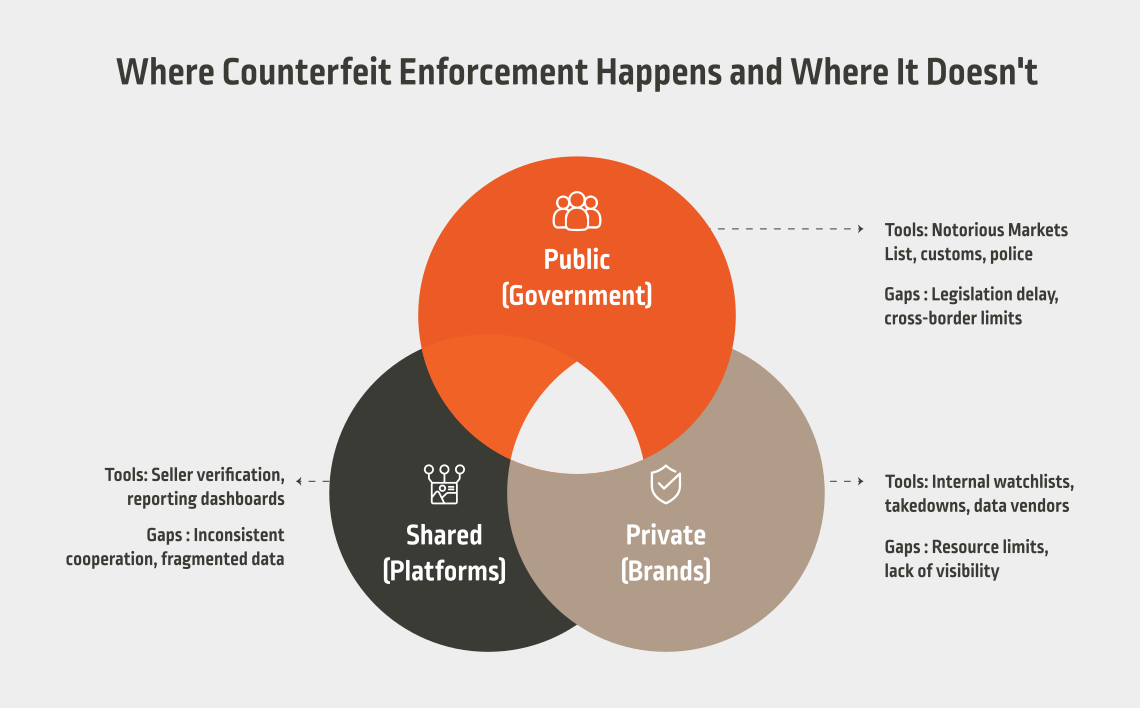
Real progress happens in the overlap between policy and practice:
-
Public lists raise awareness and diplomatic pressure.
-
Transparency laws make sellers traceable.
-
Private watchlists connect patterns and catch repeat offenders faster than any annual report can.
-
AI-native investigative environments, like Hubstream, give investigators a way to work across those fragmented signals, linking marketplace listings, seller aliases, and enforcement history into a single evidentiary picture instead of a static list.
The list will keep naming markets once a year. The harder discipline, connecting what it names to what it misses, happens every day in between. The question worth carrying forward isn’t whether a given market makes next year’s list. It’s what has to be tracked continuously so that its absence would actually mean something.