
Temu’s Counterfeit Problem Outlived the Loophole Everyone Blamed for It
For three years, brand protection teams had a tidy explanation for why counterfeit goods kept moving through Temu at volume: the $800 de minimis exemption let low-value parcels from China enter the United States without tariffs or the customs inspection larger shipments face. Break a shipment into thousands of small, direct-to-consumer parcels and you break the enforcement model along with it.
That explanation is no longer available. Executive Order 14256 ended de minimis treatment for China and Hong Kong-origin goods on May 2, 2025, and the exemption was suspended for every other country by August 29, 2025. The mechanism brand protection teams had spent years pointing to is gone. The counterfeit listings are not.
This is worth sitting with, because it says something the loophole narrative never could: de minimis was one lever counterfeiters used, not the reason the system worked in their favor. The listings, the review manipulation, the cybersquatting, the keyword camouflage, all of it, ran on platform architecture that has nothing to do with tariff classification.
What the Loophole Actually Explained, and What It Didn’t
Temu, which launched in the United States in September 2022, built its growth on direct shipment from Chinese factories and warehouses at prices often 90% below traditional retail. The de minimis exemption made that model tariff-efficient. It never explained why a search for a generic phrase like “car light up sign” surfaces a counterfeit Uber or Lyft LED sign, or why a skincare brand’s own name in a product title can lead a shopper straight to a fake.
Those outcomes come from how listings are created, ranked, and verified, a layer of the platform that trade policy does not touch.
The Techniques That Never Depended on the Border
Unauthorized use of brand names, logos, and images remains the most common tactic, and it works the same way regardless of where the tariff line sits.
Keyword Camouflage: Counterfeit products are frequently disguised with functional or misspelled keywords, so a search for “Car Light Up Sign” can surface fake Uber or Lyft LED signs.
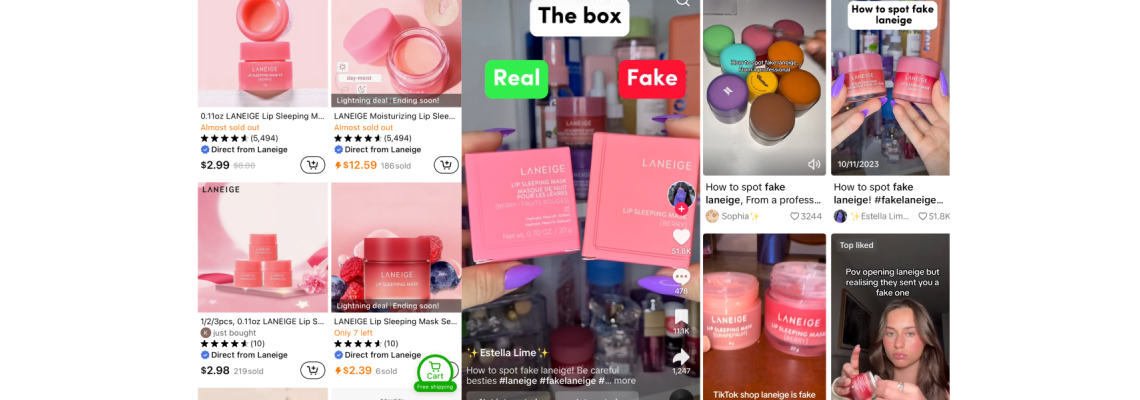
Laneige Counterfeits: The skincare brand faced a sustained flood of counterfeit lip sleeping masks on Temu, listed under its own name, logo, and product photography. Laneige eventually built its own reporting portal rather than rely on the platform’s queue.
 Source: Glossy
 Source: Business Insider
Grey Market Arbitrage and Fake Marketplaces
Grey market activity on Temu works by exploiting regional price gaps: sellers buy authentic goods, often electronics, where prices are lowest and resell them elsewhere without the brand’s consent, bypassing authorized distribution and often stripping out warranty coverage in the process. A Samsung Galaxy phone bought abroad and resold in the U.S. looks like a minor discount at the level of one listing. Multiplied across thousands of listings, it becomes a measurable drain on authorized retailers.
Cybersquatting compounds the problem. In November 2023, Temu sued 20 domains, including temuapp.biz and temudeals.store, for building fake apps and lookalike marketplaces that either delivered counterfeit goods or nothing at all. And manipulated reviews, often recycled across listings or incentivized through referral promotions, manufacture the trust signal that lets a counterfeit listing survive a shopper’s second glance.
The Regulatory Response Is Real, and Still Narrow
Enforcement has caught up in places, but not on counterfeiting specifically. In September 2025, the FTC secured a $2 million penalty from Whaleco, Temu’s operator, for violations of the INFORM Consumers Act, a law aimed at seller identity verification, not IP infringement. The European Commission designated Temu a Very Large Online Platform under the Digital Services Act in 2024, obligating risk assessments that cover counterfeit and unsafe goods among other harms.
Brands themselves are still the ones filing IP-specific claims. Twenty One Pilots sued Temu over counterfeit band merchandise, and in early 2026 a federal judge declined to let Temu’s arbitration clause block a nationwide class action from moving forward, even as more than 6,500 individual arbitration demands were dismissed in the same ruling. None of this closes a listing today. It builds a slower, parallel form of pressure that brand protection teams cannot rely on for immediate removal.
That leaves brands where they started: the fastest lever is still Temu’s own Intellectual Property Complaint portal, a process brands describe as slow and easy to get wrong on the first submission, but one that works when documentation is complete and tracked closely.
The Question That Matters More Than the Loophole
If closing de minimis didn’t close the listings, the practical question shifts. It is no longer “how do we get this shipment stopped at the border.” It is “how do we see a seller who reappears under a new name, a new domain, and a new storefront before they rebuild the audience they lost.” Border enforcement, however tightened, only ever addressed the physical movement of goods. It was never built to see a seller identity persist across a cybersquatted domain, a resold-inventory listing, and a fresh account with recycled reviews.
That is a data problem before it is a legal one. A brand that treats a delisted seller, a fake domain from the November 2023 lawsuit, and a resold-electronics listing as three unrelated events will keep re-discovering the same actor. A brand that can connect those signals, shared images, recycled review language, matching account creation patterns, gets ahead of the relist instead of reacting to it. This is the kind of cross-source pattern work platforms like Hubstream are built around: not another queue for takedown requests, but a way to see whether today’s new listing is actually yesterday’s seller under a different name.
Questions Worth Asking About Your Own Program
Before assuming a policy change will do the enforcement work: has your team confirmed whether a seller removed under one name has resurfaced under another, or is that assumption untested? Does your monitoring treat a cybersquatted domain and a marketplace listing as connected evidence, or as two separate reports? And when a takedown succeeds, does anyone check whether the underlying seller identity, not just the listing, actually stopped operating?
De minimis closing was a real structural change. Whether it changes the volume of counterfeit goods reaching U.S. consumers, or simply changes which channel they arrive through, domestic fulfillment, resale platforms, social commerce, is still an open question. The brands that answer it first will be the ones already watching for the seller, not just the shipment.
How Can Hubstream Help You?
Build a centralized reporting data hub to consolidate counterfeit data for streamlined management.
Use AI capability to prioritize repeat offenders and stop playing internet Whack-A-Mole.
Connect online and offline data to build viable cases against bad actors.
Help teams make actionable decisions to protect brand integrity before its too late.