
Amazon’s Counterfeit Notices Fell 35%: The Data Didn’t Grow, It Got Connected
In its 2022 Brand Protection Report, Amazon disclosed that the number of valid infringement notices filed by brands through Brand Registry fell by more than 35% year over year, even as enrollment in the program kept growing and the platform seized over six million counterfeit products. A drop like that usually reads as a warning sign: brands finding less, or giving up on reporting what they find. Here it meant the opposite. Amazon’s own detection systems, fed by the reference data brands had already submitted through Brand Registry, started catching and removing counterfeit listings before a brand’s team had to file anything at all.
The brands didn’t do less work by monitoring less. They did less work because the data they were already producing, product images, trademark registrations, authorized seller lists, had been structured into something Amazon’s systems could act on directly.
“Data-Driven” Usually Means More Collection. That’s Not What Worked Here
Ask most brand protection teams what a more data-driven strategy would look like and the answer tends to involve collecting more: more social listening, more marketplace scraping, more customer complaint surveys. None of that is wrong on its own. But the Amazon case is a useful check on the assumption, because the brands in Brand Registry weren’t necessarily collecting more raw information than they had before. What changed was whether that information existed in a form a platform’s own enforcement system could query against, automatically, without a brand analyst filing a manual notice for every instance.
What the Pattern Looks Like Outside Retail
Pharmaceutical supply chains
The FDA’s drug supply chain integrity reporting system works on the same logic: individual reports about medication quality or authenticity are only useful once they land in one place a regulator can query across products, regions, and time. The value isn’t any single report. It’s that the reports are structured to be comparable to each other.
Consumer electronics
Apple’s removal of more than a million counterfeit listings in a single year depended on evidence, images, seller records, prior complaints, that had already been organized into a form enforcement teams could act on at that scale. Industrial-scale takedowns don’t run on case-by-case manual review; they run on structured evidence that a system can process in bulk.
Retail more broadly
Global retail e-commerce was projected to reach $5.9 trillion in 2023, and counterfeit volume grew alongside it, not because brands had less data about their own sales and reviews, but because the connective layer between that internal data and the marketplaces where infringement actually happens is still, for most brands, manual and ad hoc.
The Harder Question: Is More Data Even the Right Fix?
This isn’t true for every brand. A smaller company with no formal monitoring in place genuinely does need to start by collecting more, sales data, social mentions, customer complaints, before connectivity becomes the relevant problem. But for teams that are already sitting on marketplace reports, survey data, and case histories, the honest diagnosis is usually not “we don’t have enough information.” It’s that the information exists in disconnected places, an inbox here, a spreadsheet there, a platform’s own portal somewhere else, and nothing links a pattern seen in one place to a similar pattern reported somewhere else six months earlier.
That distinction matters because the two problems have different fixes. A brand short on data needs more monitoring. A brand short on connectivity needs a structured, shared record, and no amount of additional monitoring volume substitutes for that.
What Connected Data Actually Requires
Getting to what Amazon’s Brand Registry achieves for its enrolled brands, detection acting on submitted reference data without a manual notice for every instance, depends on a few specific things, not a bigger dashboard:
A record that survives the person who created it
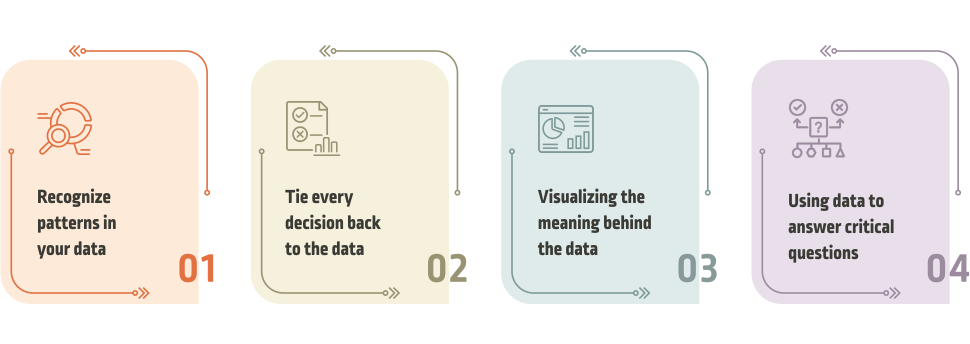
If a pattern identified last year lives only in the memory of the analyst who found it, it isn’t structured data yet. It needs to be retrievable by whoever looks next, regardless of who’s still on the team.
Reference data platforms and partners can query directly
Amazon’s model works because brands feed structured reference material into a system the platform’s own detection can check against automatically. A brand’s authorized seller list or trademark registry sitting in an internal file does nothing for that comparison until it’s shared in a form the other side can use.
Cross-referencing new reports against case history, not just current activity
A new marketplace flag is more useful the moment it can be checked against every prior confirmed case touching the same seller, image, or redirect domain, not reviewed in isolation as though it were the first instance anyone has seen.
Asking what decision the data needs to support
Amazon didn’t just collect more from brands. It used specific submissions, product images, authorized seller lists, to answer one recurring decision: is this listing legitimate. Data collected without a decision attached to it tends to sit unused.
Where This Connects to Hubstream
Hubstream is built around the same distinction the Amazon example makes visible: the constraint most brand protection teams face isn’t a shortage of data, it’s a shortage of connection between the data that already exists across cases, platforms, and time. An investigative environment that keeps that record structured and queryable, rather than one more dashboard sitting next to the others, is what lets a new report get checked against everything a team has already found instead of starting over.
Amazon’s 35% drop wasn’t a sign that counterfeiting slowed down. It was a sign that the connection between brand data and enforcement data had improved enough that fewer humans needed to manually bridge the gap. That’s a reasonable test to apply to your own program: not how much data your team collects, but how much of it another person, platform, or system could act on without you explaining it to them first.