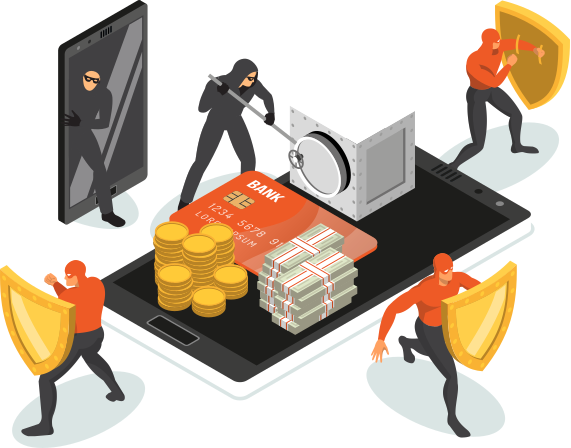
Financial & Money Crimes: The Paper Trail Became a Blockchain
Since the pandemic, digital commerce has turned into a free-for-all of instant payments, P2P (Peer-to-Peer) apps, neobanks, and crypto rails. What used to be a simple paper trail is now an actual maze.
Micro-transactions slip down one corridor, synthetic IDs disappear down another, mule accounts split into side passages, and mixers quietly redraw the path behind them. It’s fast, intentionally fragmented, and built to exhaust even the most disciplined audit teams.
But the maze isn’t winning anymore.
In this third chapter of our Criminal Minds, Rewired: How AI Is Transforming Investigations series, we’ll talk about how AI restores financial visibility, and why investigators, not algorithms, are the ones steering the fight.
The Big Picture: The Cashless Crime Economy
If you’ve ever opened a transaction log and felt like you were staring at a spilled box of cables, welcome to the cashless crime economy. Every year, more financial activity shifts into instant payments, neobanks, prepaid cards, crypto exchanges, and P2P rails.
What used to be a single audit trail is now five different partial ones, each with its own format, latency, and blind spots.
Criminal networks know this.
They automate laundering the same way marketers automate email. Bots break transactions into tiny pieces, funds jump across blockchains, identity farms produce synthetic customers on demand, and mule recruits get pulled in within minutes.
Meanwhile, banks and fintechs are stuck juggling rising compliance costs, exploding alert queues, and typologies that evolve faster than their rule engines.
Legacy AML systems simply weren’t built for this scale. It’s why analysts spend more time clearing false positives than finding actual crime and why RegTech investment is projected to double by 2029.
Layer on the growing scrutiny around how these systems make decisions, whether risk models are transparent, whether scoring can be applied fairly, and whether monitoring stays within ethical boundaries, and the pressure becomes obvious.
Criminals scaled with automation. Now investigators need augmentation that’s equally fast, equally adaptive, and explainable.
The New Investigative Challenge: Speed, Scale, and Fragmentation
If you think the cashless world is chaotic, the investigation side is even more so. Financial crime investigation teams don’t struggle because of a lack of data, but because that data is spread all over the place.
For example, ID-verification (KYC) files live in one system, case notes are hidden in PDFs, and crypto intelligence is stored in a tool accessible to only a few specialists. When this level of disorganization is multiplied across regions and teams, the word ‘fragmented’ severely understates the operational challenges that follow.
Another challenge financial crime investigation teams face today is that the systems they rely on were built for technical specialists, not for fast-moving investigations across jurisdictions. As Deloitte point out, legacy solutions often suffer from lack of customization, weak alignment between risk assessment and monitoring processes, slow responsiveness to emerging threats, and unclear data-mapping. Meanwhile, it’s been reported that conventional AML systems generate false-positive rates of up to 95%, overwhelming compliance teams and diverting resources away from real threats.
As a result, while criminals are leveraging global mule networks, rapid cross-border money flows and instant blockchain hops, investigators are hampered by systems that were never architected for modern financial-crime complexity. This gap creates operational bottlenecks, increases regulatory risk, and erodes visibility just when speed and agility matter most.
The AI Transformation: From Fragmented Trails to Clearer Insight
When people talk about ‘AI’ to solve financial crime and imaginations go wild—either a silver bullet or robot detectives. The truth is AI isn’t a replacement of modern investigators; it’s a partner that gives investigators the visibility they’ve never had before.
Here’s what that looks like in practice:
-
Agentic AI as a co-pilot: Helps pull cases together by reviewing histories, grouping related transactions, spotting odd patterns, and highlighting what needs attention first. It takes the load off manual triage so investigators can focus on creating better outcomes.
-
Graph-based entity networks or link analysis for messy data flows: Brings wallets, accounts, crypto hops, and mule activity into a single view. Circular flows, layering patterns, and synthetic ID webs become easy to spot, even when criminals try to hide them behind mixers.
-
AI-powered document and data cleanup: Converts PDFs, invoices, and vendor files into clean, searchable information. It picks up repeated details, shared identifiers, and hidden relationships that are hard to catch manually.
-
Unified data fusion: Pulls OSINT, corporate records, darknet intel, warrants, and blockchain data into one narrative instead of scattered files. With everything connected, patterns appear that human eyes simply miss.
This is where Hubstream’s approach really shines.
When all those data signals are stored inside a unified data hub, AI has the context it needs, and investigators get the clarity they’ve been missing. It’s the difference between chasing criminals’ tails and seeing clear insights of operations.
Real-World Proof: AI vs Financial Crime in Practice
AI is changing the investigative landscape, look at the teams already putting it to work.
HSBC’s Dynamic Risk Assessment, built with Google Cloud, checks over 900 million transactions a month and spots patterns legacy systems never could. The bank reports higher detection rates and roughly 60% fewer false positives, a massive win for investigators buried in noise.
The public sector is seeing similar gains. A U.S. Department of the Treasury program used AI to screen trillions in transactions, prevent $4 billion in fraud, and recover $1 billion in check fraud. That’s not just proof of concept. That’s operational impact.
Action Steps for Investigators: What Leading Teams Do Next
Alert volumes are rising everywhere, and most teams feel pressure. The good news is you don’t need a big overhaul. The teams making real progress start small and fix what’s slowing them down.
A practical roadmap usually begins with four steps:
Strengthen the data foundation.
Bring KYC records, transactions, OSINT, and crypto intelligence into one environment. With Hubstream, investigators and analysts can manage, standardize, and de-duplicate data—without writing code.
Start small with high-impact pilots.
Focus first on the workflows that consume most of the time, such as case summaries, Suspicious Activity Report (SAR) preparation, or entity-based triage. Hubstream helps teams capture quick wins and build confidence across regions.
Prioritize explainability over coding.
Investigators don’t need to engineer models—they need to understand their reasoning. What triggered an alert? How were entities connected? Which signals mattered? Hubstream supports this transparency and keeps human judgment central to the process.
Establish governance early.
Bias checks, privacy controls, human review, and audit trails should be in place before scaling. These safeguards protect teams from black-box scoring and unintended account actions.
Once these fundamentals are set, integration becomes the key advantage. Hubstream can connect data from spreadsheets, platforms, or APIs—regardless of location—so every entity, alert, and evidence fragment links together, transforming scattered information into a clear, end-to-end investigative story.
The Shift Toward AI-Assisted Investigations
The real power of AI isn’t automation—it’s illumination. It brings clarity instead of clutter, speed instead of delay, and connections that turn scattered clues into a single story.
With that power, investigators can see the full picture, make sharper decisions, and create impact once thought out of reach.
In the next part of this series, we shift from financial systems to something even more complex: violent crime scenes—where AI helps investigators navigate terabytes of evidence, one frame at a time.
Stay tuned.